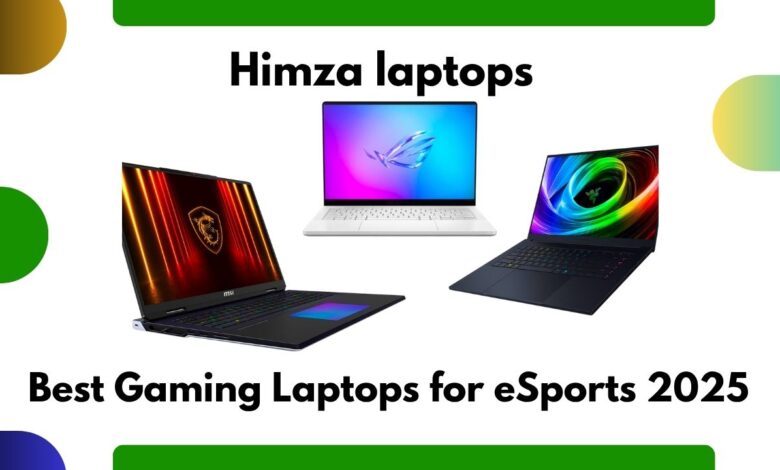
Best Gaming Laptops for eSports 2025 | High FPS for Competitive Play
Best Gaming Laptops for eSports 2025

The Best Gaming Laptops for eSports Players in 2025
For competitive eSports players, every millisecond counts. Your laptop needs to be a reliable weapon that delivers flawless performance when it matters most. The best gaming laptops for eSports players are not just about raw power; they are about speed, responsiveness, and stability. This guide focuses on the key features that give you a competitive edge in games like Valorant, *Counter-Strike 2*, and Fortnite.
What Makes a Laptop Great for eSports?
The needs of an eSports athlete are unique. You don’t necessarily need a laptop that can run the most graphically intense single-player games at 4K. Instead, you need a machine built for speed. Here are the non-negotiable features of the best gaming laptops for eSports players:
1. High Refresh Rate Display: The #1 Priority
The most critical feature is the screen. You need a high refresh rate display. While 144Hz is good, the best gaming laptops for eSports players now feature 240Hz, 300Hz, or even 480Hz panels. This means the screen updates up to 480 times per second, making motion incredibly smooth and helping you track fast-moving enemies more easily.
2. Powerful CPU for High Frame Rates
In competitive games, the CPU is often as important as the GPU. These games are designed to run on many different computers, so they rely heavily on the processor to calculate game logic and physics. A powerful CPU, like an Intel Core i7 or i9, or an AMD Ryzen 7 or 9, is essential for achieving the highest possible FPS (Frames Per Second).
3. Fast GPU for Consistent Performance
You need a graphics card that can push those high frame rates without any stuttering. A NVIDIA GeForce RTX 4060 or higher is ideal. These GPUs ensure you never drop below your monitor’s refresh rate during a crucial fight.
Top Gaming Laptops for eSports Players in 2025
| Laptop Model | Key Feature | Best For |
|---|---|---|
| ASUS ROG Strix SCAR 18 | Extreme 240Hz+ Display | Professional-level players who need the absolute best speed. |
| Lenovo Legion Pro 7i | Balanced Performance & Cooling | Players who want reliable, consistent FPS during long sessions. |
| Acer Predator Helios 16 | High Wattage GPU | Gamers wanting maximum power for high frames in any title. |
| MSI Raider GE68 HX | Vibrant Mini-LED Display | Players who value visual clarity and color for spotting enemies. |
1. ASUS ROG Strix SCAR 18: The eSports Specialist
This laptop is built with competitive gaming in mind. It often features the fastest available processors and incredibly high-refresh-rate displays. Its responsive keyboard and minimal bloatware make it a top choice for the best gaming laptops for eSports players.
2. Lenovo Legion Pro 7i: The Reliable Workhorse
The Legion Pro 7i is known for its outstanding cooling system, which prevents performance drops during long tournaments or practice sessions. It delivers top-tier frame rates with a clean and professional design.
3. Acer Predator Helios 16: The Powerhouse
The Predator Helios 16 packs high-wattage components, meaning the GPU and CPU run at their full potential. This translates to incredibly high and stable frame rates, making it a formidable machine for any competitive title.
For in-depth technical reviews and performance benchmarks, a great external resource is Notebookcheck, which provides incredibly detailed display and input lag analysis.
Key Requirements for an eSports Laptop
Before you buy, use this checklist to ensure you’re getting a true competitive machine.
| Component | Recommended Spec for eSports | Why It Matters |
|---|---|---|
| Display Refresh Rate | 240Hz or Higher | Smoother motion and reduced blur for tracking targets. |
| CPU (Processor) | Intel Core i7/i9 or AMD Ryzen 7/9 | Maximizes FPS and reduces latency in CPU-heavy games. |
| GPU (Graphics) | NVIDIA RTX 4060 or higher | Ensures high frame rates stay stable during intense action. |
| RAM | 16GB DDR5 | Prevents stutters and allows for background apps like Discord. |
Frequently Asked Questions (FAQs)
Q1: Is a 144Hz display enough for competitive gaming?
A 144Hz display is good, but for serious competitive play, 240Hz or higher is recommended. The difference in smoothness and responsiveness is noticeable and can provide a real advantage.
Q2: Why is the CPU so important for eSports laptops?
Games like Valorant and CS2 are engineered to be less dependent on the GPU and more on the CPU for calculating player movement, shots, and game physics. A faster CPU directly results in higher FPS.
Q3: Do I need an RTX 4080 or 4090 for eSports?
No, that is overkill. An RTX 4060 or 4070 is more than enough to achieve very high frame rates in most competitive titles at 1080p or 1440p resolutions.
Q4: How important is a fast SSD for eSports?
A fast SSD (NVMe) is crucial for loading into matches quickly and reducing map loading times. This ensures you’re always ready from the start of a round.
Q5: What screen size is best for eSports?
15-inch to 16-inch models are the most popular. They offer a good balance between screen space and portability, allowing your eyes to easily see all action without excessive movement.
Conclusion
Choosing the best gaming laptops for eSports players comes down to a focus on speed above all else. You need a high-refresh-rate display, a powerful CPU, and a reliable GPU that work together to deliver the highest and most stable frame rates possible. Models like the ASUS ROG Strix SCAR 18 and Lenovo Legion Pro 7i are engineered to meet these exact demands. By investing in a laptop built for competition, you equip yourself with the tools needed to perform at your peak and climb the ranks.